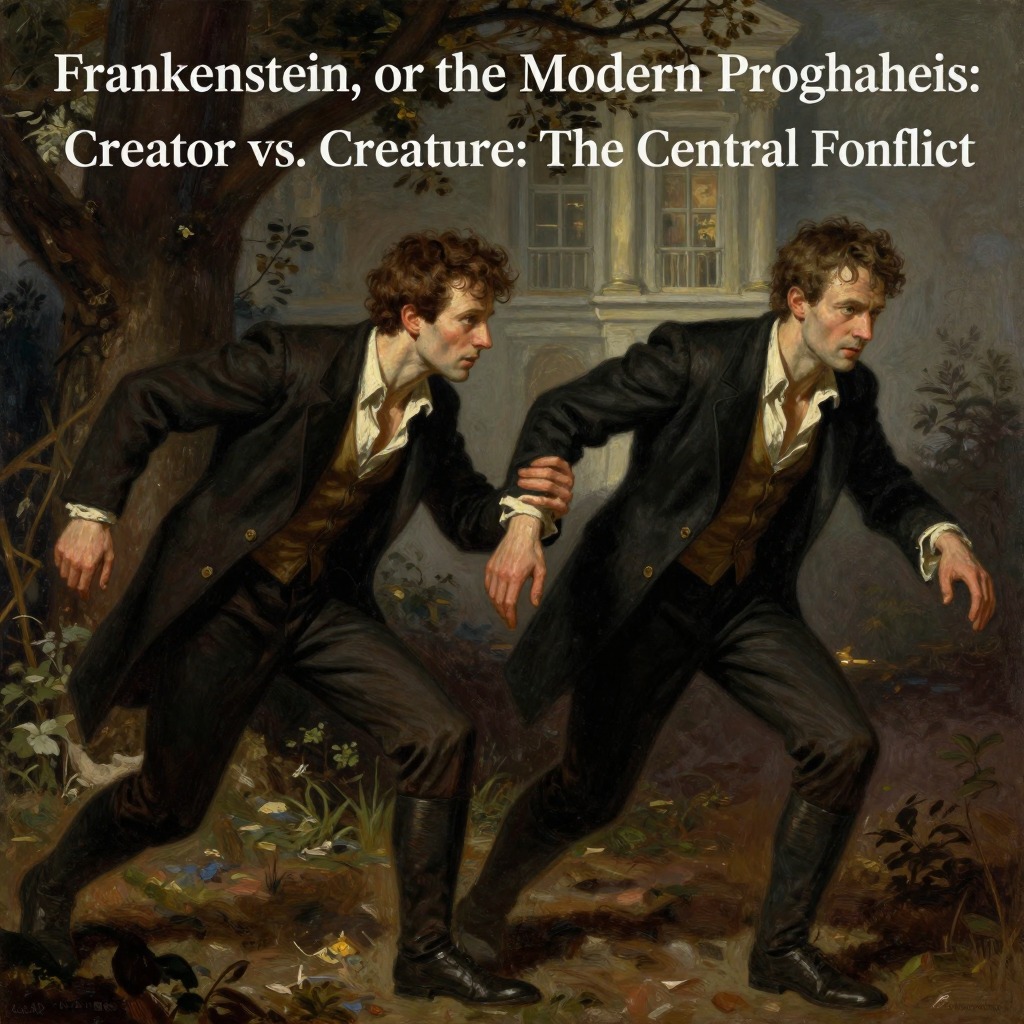
Victor Frankenstein and the Monster
Victor Frankenstein and the monster he brings to life are locked in a relationship that defines the novel's moral and emotional landscape: a creator who recoils from his own creation, a creature who craves the affection he is denied, and a cycle of abandonment, revenge, and mutual destruction that leaves no one untouched. Their bond is forged in a single catastrophic act and unravels across continents, through murders and confessions, until both lie dead — one by exhaustion, the other by his own hand — on the ice of the Arctic.
Creation and Immediate Rejection
The relationship begins in Victor's squalid Ingolstadt laboratory on a dreary November night. After nearly two years of obsessive work, Victor infuses life into a composite of dead matter and is instantly horrified by what he has made. The creature's yellow skin, watery eyes, and straight black lips, combined with his gigantic eight-foot frame, provoke in Victor not pride but "breathless horror and disgust." He flees the room, and when the creature follows and reaches out a hand, Victor escapes into the courtyard, spending the night in terrified agitation. That first rejection is decisive: Victor abandons his creation before the creature has spoken a word, before he has done any harm. The monster, left alone and bewildered, wanders into the forest near Ingolstadt, beginning a long education in solitude and suffering that will shape his character.
The Monster's Education and the Demand for a Companion
After months of hiding in a hovel attached to the De Laceys' cottage, the monster learns language, history, and human affection by observing the family. He discovers Victor's journal in the pocket of a coat taken from the laboratory and reads the detailed account of his own creation — the "disgusting circumstances" that produced him. The journal confirms his worst fears: his creator loathed him from the start. Yet the monster still hopes for kindness. He approaches the blind De Lacey, who receives him with sympathy, but when Felix, Agatha, and Safie return, they react with horror. Felix tears the monster from his father and strikes him with a stick. The monster, though capable of killing Felix, refrains and flees. That night, in despair, he burns the cottage to the ground. His transformation from benevolent to vengeful is complete. He resolves to find Victor, his creator, and demand a female companion — the only remedy for his isolation.
The Confrontation on the Glacier and the Promise
Victor, already shattered by the deaths of William and Justine — both caused by the monster — retreats to the glacier at Montanvert seeking solace. There the monster confronts him, speaking with eloquence and force. He recounts his suffering, his rejection by the De Laceys, and his loneliness. "I was benevolent and good; misery made me a fiend," he tells Victor. He demands that Victor create a female of his own kind, promising to flee with her to South America and never trouble humanity again. Victor, moved by the monster's arguments and terrified by his threats, reluctantly agrees. "I consent to your demand," he says, "on your solemn oath to quit Europe forever." The monster swears by the sun and sky, and the pact is made.
The Broken Promise and the Wedding-Night Threat
Victor travels to the Orkney Islands to fulfill his promise, but as he works on the female creature, doubt overwhelms him. He imagines the pair might hate each other, or breed a race of devils, or that the female might refuse to leave Europe. In a moment of revulsion, he tears the half-finished female to pieces. The monster, watching through the window, lets out a howl of despair and revenge. He confronts Victor and delivers his final threat: "I shall be with you on your wedding-night." Victor interprets this as a promise of his own death, but the monster's vengeance is more precise. He murders Henry Clerval, Victor's closest friend, and frames Victor for the crime, leading to a brief imprisonment in Ireland. After Victor's release and return to Geneva, he marries Elizabeth Lavenza, believing the monster will attack him on their wedding night. Instead, the monster enters Elizabeth's room and strangles her. Victor arrives to find her body and sees the monster at the window, grinning.
The Pursuit and the End
With his family destroyed — William, Justine, Clerval, Elizabeth, and finally his father Alphonse, who dies of grief — Victor dedicates himself entirely to revenge. He swears an oath over the graves of his loved ones to pursue the monster until one of them perishes. The chase carries him across Europe, through Russia and Tartary, and finally onto the Arctic ice. He procures a sledge and dogs and gains on the monster until a ground sea splits the ice, leaving Victor adrift on a fragment. He is rescued by Robert Walton's ship, where he tells his story. On his deathbed, Victor urges Walton to continue the pursuit, but also warns him against the dangers of ambition. "Seek happiness in tranquillity and avoid ambition," he says. After Victor dies, the monster enters the cabin, mourning over his creator's body. He speaks of his own remorse and declares that he will build a funeral pyre in the far north and die. "I shall die," he says. "I shall no longer feel the agonies which now consume me." He leaps from the cabin window onto an ice raft and is lost in darkness and distance.
Thematic Significance
The relationship between Victor and the monster is the novel's central engine, embodying its deepest themes: the danger of unchecked ambition, the responsibility of a creator toward his creation, the corrosive effects of isolation, and the cycle of revenge. Victor's failure to love or guide the monster transforms a potentially benevolent being into a murderer. The monster, in turn, becomes a mirror of Victor's own flaws — his pride, his secrecy, his refusal to face consequences. Each is the other's victim and tormentor. Their bond is a tragedy of mutual creation: Victor makes the monster's body, but the monster makes Victor's misery. In the end, neither can live without the other, and both are consumed by the hatred that binds them.